
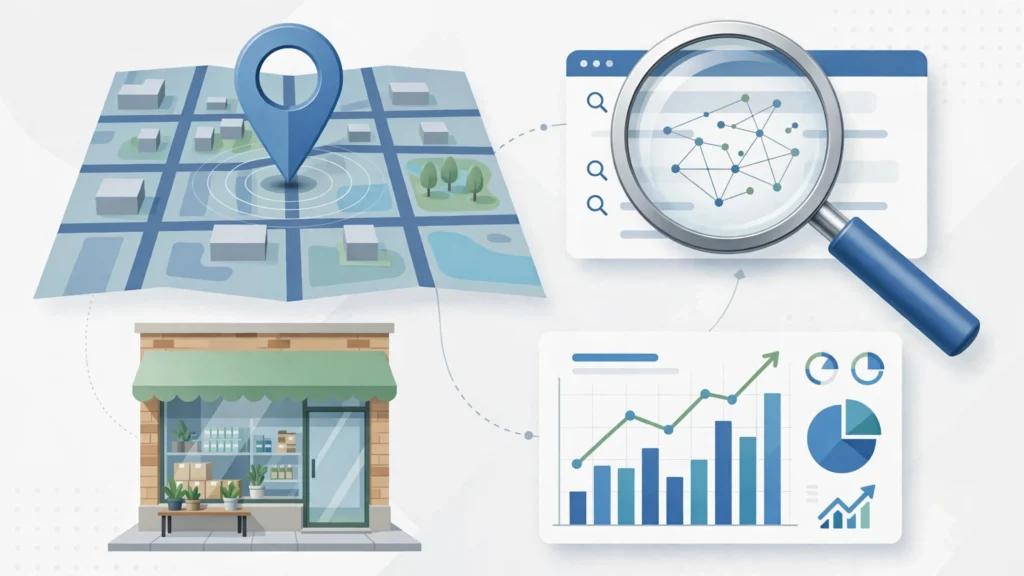
Local SEO is the difference between a business that shows up when nearby customers search and one that stays invisible no matter how good its products or services are. When someone types “plumber near me” or “best bakery in [your city],” the results
they see aren’t random — they’re shaped by a specific set of ranking signals tied to location, relevance, and trust. Businesses that understand and optimize for these signals consistently win the map pack and the organic results above their competitors.
Many business owners assume local SEO means simply listing an address on a website. In reality, it’s a layered strategy involving your Google Business Profile, consistent citations across directories, a steady stream of reviews, location-specific content, and technical fundamentals like mobile speed and structured data. Skipping any one of these layers weakens the entire system.
This guide breaks down exactly how to rank higher in your city or region, step by step, using the same tactics that consistently rank businesses in competitive local markets. You’ll learn how to optimize your Google Business Profile, build the right citations, earn and manage reviews, create location pages that actually convert, and track the metrics that matter.
Whether you’re a solo service provider or manage a multi-location business, this framework will give you a clear, actionable path to greater local visibility.
Local SEO is the practice of optimizing your online presence so your business appears in search results when people search for nearby products or services. Unlike traditional SEO, which competes for visibility across a broad, often global audience, local SEO focuses specifically on connecting your business with searchers in a defined geographic area — a city, region, or neighborhood.
A few numbers make the case clearly:
For any business that depends on local customers — restaurants, law firms, medical practices, contractors, salons, and retail stores — local SEO is often the single most cost-effective marketing channel available, because it reaches people at the exact moment they’re ready to buy.
Your Google Business Profile (GBP) is the single most influential factor in local search rankings. It’s what powers your appearance in the map pack, Google Maps, and local organic results.
Fill out every available field, including:
Incomplete profiles consistently rank lower than fully optimized ones, since Google rewards profiles that give it more confidence about what your business actually offers.
Google’s own Business Profile help center outlines the specific fields and verification steps required to keep your profile in good standing, which is worth reviewing directly if you’re setting up a profile for the first time.
A citation is any online mention of your business Name, Address, and Phone number (NAP), typically on directories, review sites, or industry platforms. Search engines use citation consistency as a trust signal — if your NAP details differ across the web, it creates confusion that can suppress your rankings.
Inconsistent citations are one of the most common — and most overlooked — reasons a business fails to rank despite strong website content.
Reviews influence local rankings and purchase decisions in roughly equal measure. Most consumers read reviews before choosing a local business, and expectations for star ratings continue to climb.
Search engines and consumers alike weigh both the volume of reviews and how recent they are. A business with 200 reviews from three years ago can rank below a competitor with 40 reviews from the last two months. Building a consistent, ongoing review request process — not a one-time push — is essential for local SEO success over time.
Your website needs to reinforce the same local signals as your Google Business Profile.
/plumbing-services-austin rather than /services-2).If your business serves multiple cities or neighborhoods, dedicated location pages are far more effective than a single generic page listing every city you serve. Each page should include:
Avoid duplicating the same content across location pages with only the city name swapped out — search engines increasingly penalize this kind of thin, templated content.
Effective local keyword targeting starts with understanding how your customers actually search.
Incorporate these terms naturally into your page titles, headers, body content, and image alt text — never force keywords in a way that reads unnaturally to visitors.
Backlinks from other local, relevant websites signal geographic relevance to search engines, much like citations do, but with added authority weight.
Quality matters more than quantity here. A handful of links from respected local organizations will outperform dozens of low-quality directory links.
Even the best local content strategy underperforms if your website has technical weaknesses.
Structured data in particular reinforces every other local signal you’ve built for your local SEO strategy — it doesn’t replace your citations or reviews, but it strengthens how confidently search engines can connect them to your business.
While social signals aren’t a direct ranking factor in the same way as citations or reviews, an active local presence supports your broader visibility.
This activity builds brand recognition that often translates into more direct searches for your business name — a strong secondary signal for local rankings.
You can’t improve what you don’t measure. Focus on a core set of metrics to evaluate your local SEO performance over time:
Reviewing these local SEO metrics monthly allows you to spot which locations or tactics need more attention before a competitor pulls ahead.
Businesses operating in several cities face a unique set of local SEO challenges, since each location competes in its own local search landscape.
Franchise and multi-location brands often struggle with cannibalization, where near-identical pages compete against each other for the same local SEO keywords. To avoid this, keep each location page focused on its specific service area, local team, and community involvement, so search engines can clearly distinguish one branch from another.
Centralizing citation and review management under a consistent process also prevents individual locations from drifting out of alignment with brand-wide NAP standards.
How long does it take to rank higher in local search?
Most businesses see measurable improvement within three to six months of consistent optimization, though highly competitive markets may take longer.
Is Google Business Profile more important than my website for local SEO?
Both matter, but your Google Business Profile typically has the most direct impact on map pack visibility, while your website supports organic rankings and conversions.
Do I need a separate page for every city I serve?
Yes, if you genuinely serve multiple distinct areas. Unique, well-written location pages consistently outperform a single generic service-area page.
Ranking higher in your city or region isn’t the result of one single tactic — it comes from a handful of signals working together consistently over time. A fully optimized Google Business Profile, consistent NAP citations, a steady stream of recent reviews, location-specific website content, relevant local backlinks, and solid technical fundamentals all reinforce one another to build lasting local SEO visibility. Businesses that treat local SEO as an ongoing practice, rather than a one-time setup task, are the ones that consistently outrank competitors and convert nearby searchers into paying customers.

Contributor at SavingGuideHub, writing practical guides on finance, savings, and insurance.

Sharing practical finance and savings guidance.